7-day creative hobby woodworking basics exploration with guided to self-practice transitions itinerary 2026
The idea of a 7-day creative hobby woodworking basics exploration with guided to self-practice transitions itinerary for 2026 resonates strongly with a growing wave of adults turning to hands-on crafts as a counterweight to screen-dominated routines. Learning how to measure, cut, join, and finish wood in a single intensive week is not only possible but well-supported by structured program formats offered by institutions across North America, Europe, and beyond. What follows is a detailed, day-by-day breakdown of how such a week typically unfolds, what participants can realistically expect to achieve, and where the friction points tend to emerge.
Why a 7-Day Format Works for Woodworking Beginners
A concentrated seven-day immersion addresses one of the core reasons beginners stall: the long gaps between practice sessions that erode newly acquired technique. Research from woodworking training platforms confirms that progress depends less on natural aptitude and more on practice frequency, with short, regular sessions consistently outperforming intermittent long ones. 1 A week-long format eliminates those gaps entirely, compressing a 90-day skill-building roadmap into a single focused experience where each day builds directly on the previous one. 2
Skill progression in structured woodworking programs commonly follows an instructional model sometimes described as guided-to-autonomous transition, where early days are instructor-led and later days shift toward independent decision-making. 3 This mirrors the pedagogical approach documented at facilities like the Marc Adams School of Woodworking, where week-long workshops are explicitly designed so students advance from tool orientation through to a near-complete project within five to seven sessions. 4 Community makerspaces and woodworking studios across Australia operate on the same principle, requiring members to complete supervised induction sessions before accessing tools independently. 5
Days 1 and 2: Safety Orientation and Foundational Hand-Tool Practice
The opening two days of any credible woodworking program are non-negotiable on safety. Participants learn personal protective equipment protocols, workspace hazard identification, and the correct body positioning for operating both hand tools and stationary power equipment. 6 At the Marc Adams School of Woodworking, the Basic Woodworking course with Marc Adams, scheduled for May 18-22, 2026, opens precisely this way: students begin the week with tool safety, setup, and proper technique for stationary power equipment and hand tools before any material is touched for a project. 4 The Introduction to Hand Tools and Their Uses course with Eric Key, running July 27-31, 2026, covers sharpening, sawing to a line, chisel use, and planing boards flat and square as foundational exercises during its early sessions. 7
Practical exercises during days one and two typically include making basic butt joints and lap joints, learning how to read wood grain, and practicing accurate measuring and marking with a tape measure, speed square, and marking knife. 2 The Year of Mud's Japanese Carpentry Workshop: Fundamentals, extended in 2026 to a full 7-day format running May 30 to June 5, 2026, at South Slope Farm in Berea, Kentucky, dedicates significant early-day time to hand tool setup, including kanna (Japanese hand plane) configuration and sharpening, before any joinery cutting begins. 8 This phase establishes the technical vocabulary every subsequent day will depend on.
Days 3 and 4: Guided Project Construction and Joinery Exploration
By day three, participants transition from isolated exercises to guided construction of a complete object. In the Marc Adams Basic Woodworking format, day three marks the beginning of a sculpted nightstand build, putting stationary power tools and hand-shaping techniques into direct practice. 4 Anderson Ranch Arts Center's Beginning Furniture Design workshop, scheduled July 20-24, 2026, takes a comparable approach: students spend the mid-week sessions making basic stools and small tables, with faculty including Brad Reed Nelson and Hayami Arakawa guiding each step of design realization through to machinery operation. The course is listed at a tuition of $1,250 plus a $300 course fee. 9
The John Henley-led Weeklong Workshop: Introduction to Design in Woodworking at Contemporary Craft in Pittsburgh, Pennsylvania, running August 3-7, 2026 from 10 AM to 5 PM daily, structures days three and four around the process of taking rough-sawn board to dimensioned lumber, then assembling multiple pieces with joinery techniques to produce a custom keepsake box. 10 The Peters Valley School of Craft's Feeling Wood: Exploring Woodworking Techniques workshop, priced at $950 and running July 8-12, 2026, introduces a particularly valuable principle during this phase: students are shown multiple approaches to any given joint or assembly challenge, reinforcing that there is rarely a single correct method, and that woodworking decisions are driven by priorities and creative judgment. 11
Days 5, 6, and 7: Self-Practice Transitions and Independent Project Completion
The final three days represent the critical pedagogical shift from guided instruction to self-directed practice. Participants who have internalized safety protocols and basic joinery are given a defined project scope and expected to execute it with minimal direct supervision. Studio Clutter's seven-day Furniture Making Intensive in Manmuqi Village near Chennai exemplifies this structure: participants of all skill levels design and build their own teak furniture across the week, with the final days devoted to independent assembly, finishing, and preparing the completed piece to take home. Three course options are available, covering a tea table, medicine cabinet, or keepsake box. 12
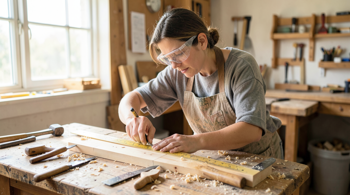
Anderson Ranch's Summer Studio Session: Furniture Design and Woodworking, running September 7-11, 2026, offers a comparable model at a more advanced level, providing each participant with an assigned studio space and five hours of weekly technical guidance while the majority of build time is self-directed. Bench and gluing rooms are open 24 hours a day during the session. 13 For self-practice days within a 7-day itinerary, woodworking training guides recommend focusing on two to three repeatable projects rather than attempting anything structurally complex, since consistent repetition of the same skills, such as gluing boards edge-to-edge, flattening glued surfaces, and applying finishes, builds the muscle memory that carries forward into independent work. 14
Realistic Skill Benchmarks and Common Friction Points
Independent data on beginner woodworking timelines provides a useful reality check for anyone planning a 7-day itinerary. Most beginners reach comfort with measuring, cutting, and basic assembly within the first three to four weeks of regular practice, meaning a single intensive week can reasonably compress participants to that threshold by day seven. 1 However, joinery complexity, such as cutting accurate dovetails or fitting frame-and-panel lids, generally requires four to six months of continued practice beyond that initial exposure before results are consistently clean. 7
Several friction points consistently affect the guided-to-self-practice transition. Beginners frequently underestimate the time required for glue curing and surface preparation, leading to rushed assemblies that compromise structural integrity. Table saws, which account for approximately 33,000 emergency room visits per year in the United States according to Consumer Product Safety Commission data cited in 2024, are among the most misused tools when supervision decreases. 15 Programs that include material costs and all-inclusive accommodation, such as The Year of Mud's Japanese Carpentry Workshop with its camping accommodations and three home-cooked meals daily, tend to produce higher completion rates because logistical friction is removed from the learning environment. 8
Tool and Material Readiness for Self-Practice Days
Before self-practice days begin, participants benefit from having internalized a minimal but functional tool set. Woodworking guides consistently identify four tools as the core beginner kit: a corded circular saw, a cordless drill and driver, a speed square, and a tape measure, with total new-purchase costs estimated at approximately $146 or around $78 for used equivalents. 16 The Marc Fish Wooden Box Making one-week course at Robinson House Studio in England, scheduled November 23-27, 2026 at a cost of £850, teaches participants the complete workflow of material selection, timber preparation, accurate cutting, gluing and clamping, hinge fitting, and finishing within the week, providing a replicable process students can apply in independent sessions afterward. 17
Material selection matters as much as tool choice during self-practice. Hardwoods such as maple, cherry, and walnut are recommended for projects where surface finish is important, while softwoods like pine are generally avoided for functional items due to susceptibility to denting. 14 In Australia, registered training organisations (RTOs) deliver woodworking competencies assessed against nationally recognised vocational qualifications, and many beginner participants in informal 7-day programs are encouraged to explore formal RTO pathways for continued development after completing their initial week. 3 Professional workshops, including those run through institutions affiliated with Craft Victoria and the Melbourne Guild of Fine Woodworking, typically conclude by providing participants with a curated list of recommended local suppliers for tools and timber to support ongoing self-practice. 5
Evaluating Program Formats and What to Examine Before Enrolling
Not all 7-day woodworking programs are equivalently structured, and prospective participants should evaluate several key factors. Instructor-to-student ratios directly affect how much individual guidance is available during the critical self-practice transition. Marc Fish's box-making course explicitly operates in small groups to ensure one-to-one tuition throughout the week. 17 Material fees, which are separate from tuition at most North American institutions, can range from $15 to $300 depending on project scope: the Basic Cabinetmaking course with Patrick Murrin at Marc Adams School, running August 24-28, 2026, carries a material fee of $260 on top of $1,050 tuition, while the Introduction to Hand Tools course lists a $60 material fee against the same $1,050 tuition base. 18
Participants should also clarify what level of prerequisite experience, if any, is assumed. Beginning Furniture Design at Anderson Ranch explicitly targets Level I students with no formal training, while the Summer Studio Session at the same institution requires prior experience with stationary machines and safety protocols and mandates portfolio submission for consideration. 9 Age eligibility, refund policies, and whether meals or accommodation are included all affect the total cost and logistical commitment of a week-long program. Wild Abundance's beginner woodworking classes near Asheville, North Carolina, for example, offer both monthly and one-time payment options alongside a flexible refund policy, which reduces financial risk for first-time participants. 19
Sources
- woodworkingtraining.com - How Long Does It Take to Learn Woodworking? (2026)
- woodcraftguide.com - Beginner Woodworking Projects: Skill-Building Roadmap for New Woodworkers 2026
- ncver.edu.au - National Centre for Vocational Education Research
- marcadams.com - Basic Woodworking with Marc Adams May 18-22, 2026
- australianmakerspace.org - Australian Makerspace Network organisational practice
- woodworkersnsw.org.au - The Woodworkers Association of NSW
- marcadams.com - Introduction to Hand Tools and Their Uses with Eric Key July 27-31, 2026
- theyearofmud.com - Japanese Carpentry Workshop 2026
- andersonranch.org - Beginning Furniture Design, Jul 20-24, 2026
- eventbrite.com - Weeklong Workshop: Introduction to Design in Woodworking with John Henley, August 3-7, 2026
- petersvalley.org - Feeling Wood: Exploring Woodworking Techniques, July 8-12, 2026
- homegrown.co.in - Studio Clutter's Furniture Making Intensive, Manmuqi Village near Chennai
- andersonranch.org - Summer Studio Session: Furniture Design and Woodworking, Sep 7-11, 2026
- plankbuild.com - 5 Beginner Woodworking Projects You Can Finish This Weekend
- benchloot.com - Beginner Woodworking Tool Kit: The Complete Guide (2026)
- plankbuild.com - How to Start Woodworking as a Complete Beginner
- marcfish.co.uk - Wooden Box Making One Week Course, November 23-27, 2026
- marcadams.com - Basic Cabinetmaking with Patrick Murrin August 24-28, 2026
- wildabundance.net - Beginner Woodworking Classes for Adults near Asheville, NC
Authored by ZenSpotter team